While I was away from Lusaka visiting my friend in Cape Town, South Africa, a Fountain of Hope grade seven student and frequent library patron named Natalie, known to friends as Natty, passed away.
The day I arrived back in Zambia, the Zambian news on TV reported from Misisi Compound on the fence being constructed around the nearby dam after many drownings. Natalie was the youngest person to perish.
Yesterday morning, I met her parents and grandmother in Misisi Compound, and they handed me a frame containing two photos of Natalie. One photo eerily featured Natalie and a friend arm in arm on a rock along the dam, the place that took her life. The second photo taken in front of one of the large tree designs on either side of the Lubuto library door. I was chilled and then silent and then tearful and offered condolences.
Ni Cho Yipa! (What a terrible thing!)
Natty spent many afternoons in the library with her friends. She listened to a few of my stories, and we perused nature books together.
On behalf of Lubuto, I give deepest sympathies to her friends, classmates and family.
Sunday, October 5, 2008

Human Rights Commission's Public Hearing for Violence Against Children

The second week of September, the Human Rights Commission in Lusaka held its inaugural Public Hearing for Violence Against Children. This public forum offered children and adults representing children a chance to voice their experiences enduring or bearing witness to human rights violations. On Wednesday, September 17th, four vulnerable children, all boys, arrived barefoot with a social worker to testify. One by one, they shared their experiences in front of the panel with the assistance of a translator. Vulnerable children in Zambia can usually speak some English, but those who have not entered school, particularly secondary school, have a difficult time communicating an entire story in English. After months, I am relatively familiar with life on the streets of Lusaka, so I had some understanding of the actions they described and recognized the names of places. Each child spoke for about twenty minutes and then answered questions from the panel. I was very impressed with their confidence and composure during the process.
The children were speaking “town Nyanja”, the most common language in Lusaka. It is an amalgam of several languages and is denoted as “town” to distinguish it from “deep Nyanja” - a slightly different dialect because it has not been cross-bred with other languages. Deep Nyanja is spoken in the Eastern province and also Malawi, and many of the kids who visit Lubuto know both town and deep Nyanja.
It surprises me how few foreigners in Zambia, aid workers or otherwise, bother to learn Zambian languages. It shocks children to hear their own language from non-Zambians, even non-Zambians who are living here for the sole purpose of helping them. I am a bit puzzled about it all, although I suppose I have a key advantage. It’s possible to learn Zambian languages only if Zambians are willing to hold your hand through the learning process. I literally have Zambians holding my hand during it! [note: I admit to knowing very little thus far.]
These are kids who would like the library. They’re kids who like to laugh. They’re kids who might happen to know my friend, John. What a coincidence! These are kids who would like the Zambian folktale from Northwestern province as much as the kids at Lubuto did when I read it to them. Maybe they’d eat nshima and beans with me at lunch. If the kids at Fountain of Hope are any indication, they would address me as “Hollywood” or “the Holly Grail”.
On the street, children form groups identified by the location around which they convene. Matthews, Abraham, and Gift are part of the City Market group a boy named Jonathan, who visits the library and returns to the street, is also from City Market. Last week, Jonathan drew me a map of the street near City Market where he begs for money during the day and asked me to visit him.
After the children were seated in the audience, I tried to maintain their level of confidence and composure and approached them.
Bwanji! Hello, how are you?
Zina langa ndine Holly. Nicokela ku America ku New York. My name is Holly. I’m from New York in America.
Cha bwino kuzibana. It’s nice to meet you.
Msebenza ku Lubuto Library ku Fountain of Hope. I work at Lubuto Library at the Fountain of Hope.
Nipuzila chi Nyanja, nikululukile. I’m learning Nyanja, sorry!
They laughed with disbelief and amusement. I read the looks on their faces as, “who is this crazy mazungu?”. [Mazungu means white person. I hear it approximately ten times a day.]
I asked them, “Hey, do you guys know Jonathan Masando from City Market?”
And they do. “John? You know John?!”
I pulled a colorful Lubuto newsletter and pamphlet from my folder. They identified the large photo of the library as Fountain of Hope. “Yes,” I agreed, “but this is the Lubuto Library inside the Fountain of Hope,” and pointed to a picture of some kids reading.
There I was, in the middle of a Human Rights Commission public hearing, making casual conversation just as I would at any social function with victims of the human rights violations that incited the hearing. It should have been a surreal moment, but it wasn’t. Perhaps it seems as if I’ve been desensitized, but that’s not the case. For me, the moment signified success.
It's not possible to help vulnerable children without becoming a part of their world. Only then is it possible to present obstacles to be overcome rather than impersonally impose solutions.
While the kids at Fountain of Hope are so fortunate to have the Lubuto library at their disposal, meeting these kids reminded me that more and more children will share the privilege as new Lubuto libraries are constructed.
Within Lusaka, there are plans for three new Lubuto libraries in Garden Compound, Kabulonga, and Lusaka West.
Monday, September 15, 2008
Introducing Barack Obama
Trevor supported Hillary Clinton and was disappointed when Democrats nominated Barack Obama. He didn't know much about Obama. If I haven't made it clear before, books are scarce and expensive in Zambia and the nearest public library is a day's drive away. When two copies of a short biography called Barack Obama: An American Story by Roberta Edwards arrived at Lubuto, I was nothing short of elated. Trevor read the book right away, and we discussed it a bit.
me: You weren't sure if Obama would make a good president the last time we talked about politics in the States.
Trevor: I didn't know much about him, but after reading this book, I know that he is smart because he started trying a long time ago and looked forward. He was speaking for those people who were uncomfortable in America, not only blacks but whites, too. He searched for what the people were thinking. He cared about people.
me: Is he different than Bush?
Trevor: Yes because where Bush makes mistakes, he [Obama] cares about what he's saying and doing. Bush cares about what he's saying most. He cares only about America, but Obama cares for the people themselves. Even the soldiers in Iraq, he said he will withdraw them if he is elected so Iraq can be free. He helps others, not just America.
me: Do you know about the person running against Obama?
Trevor: A white man. Mack?
me: Close. McCain.
Trevor: I heard from BBC radio that he was saying his medical check-up was okay so 'vote for me'!
me: Excuse me... [laughs] [laughs more] What do you think about America nominating an African-American?
Trevor: The African-Americans have suffered a lot, you know? Obama, he is not really an African-American because he has a white mother. He is both black and white.
me: Why is that important to you?
Trevor: If Barack Obama was a full African-American they wouldn't like him. He's colored so he has a chance.
me: I think the same people who wouldn't like him for being a full African-American don't like him now for being half. Do you know what I mean?
Trevor: No, I don't think you're right...His father left him, you know. Obama once visited Africa and he went to Indonesia where his stepfather took his mother.
me: What do you think about that?
Trevor: No wonder he wanted to help people, he saw what was lacking because he was not in a good situation himself. His father left him with his mom. He saw the flats that maybe had no water pipes, no toilets...just like in Misisi [the compound where Trevor lives]. He wanted to allow more people to express themselves, even those people. In short, he is a voice for the voiceless.
me: Would you vote for him if you could?
Trevor: Yeah. Yes, sure. I see potential for him to do wonders. He sees not what people are doing now, but where they are coming from and where they're going.
me: You weren't sure if Obama would make a good president the last time we talked about politics in the States.
Trevor: I didn't know much about him, but after reading this book, I know that he is smart because he started trying a long time ago and looked forward. He was speaking for those people who were uncomfortable in America, not only blacks but whites, too. He searched for what the people were thinking. He cared about people.
me: Is he different than Bush?
Trevor: Yes because where Bush makes mistakes, he [Obama] cares about what he's saying and doing. Bush cares about what he's saying most. He cares only about America, but Obama cares for the people themselves. Even the soldiers in Iraq, he said he will withdraw them if he is elected so Iraq can be free. He helps others, not just America.
me: Do you know about the person running against Obama?
Trevor: A white man. Mack?
me: Close. McCain.
Trevor: I heard from BBC radio that he was saying his medical check-up was okay so 'vote for me'!
me: Excuse me... [laughs] [laughs more] What do you think about America nominating an African-American?
Trevor: The African-Americans have suffered a lot, you know? Obama, he is not really an African-American because he has a white mother. He is both black and white.
me: Why is that important to you?
Trevor: If Barack Obama was a full African-American they wouldn't like him. He's colored so he has a chance.
me: I think the same people who wouldn't like him for being a full African-American don't like him now for being half. Do you know what I mean?
Trevor: No, I don't think you're right...His father left him, you know. Obama once visited Africa and he went to Indonesia where his stepfather took his mother.
me: What do you think about that?
Trevor: No wonder he wanted to help people, he saw what was lacking because he was not in a good situation himself. His father left him with his mom. He saw the flats that maybe had no water pipes, no toilets...just like in Misisi [the compound where Trevor lives]. He wanted to allow more people to express themselves, even those people. In short, he is a voice for the voiceless.
me: Would you vote for him if you could?
Trevor: Yeah. Yes, sure. I see potential for him to do wonders. He sees not what people are doing now, but where they are coming from and where they're going.
Wednesday, September 3, 2008
Captain Steven

Steven Siame
Steven is one of Fountain of Hope's great success stories. He was able to conquer substance abuse he developed while living on the street, and today he is attending secondary school and receiving very high grades. He is also one of the most charismatic people I've ever met. He listens to my iPod almost everyday, and his new favorite band is Radio Dept. He also likes M.I.A. and Depeche Mode a lot.
What is your position at Fountain of Hope?
I'm a captain. I am the person to set an example for the new kids who arrive from the streets. When they see me, they start to believe they can change.
Do they talk to you about it?
Yes, they say, 'Oh, Steven was living on the street, and now he's doing very well! Maybe I can change easily, too.'
Joseph and me are the two role models here. After the kids get to know us, they begin asking for advice. I was smoking on the street and stopped, so I say to them, 'It's not hard to stop. Just forget about it and do activities to keep busy. Concentrate on school, learn from your mistakes and use them to motivate yourself to change. Play football, play basketball. Just follow what I'm telling you and you'll be okay!'
Has it worked?
Yes, for many of them. I can even give you an example. Gift over there, he's changed [he was browsing the geography section]. He's now in grade 5. When he came here, he was confused. He asked, 'Why am I here? I can't get any money here. I should be out getting money!' [begging on the street] Then he asked me what to do, so I started advising him. I told him, 'If you finish school, all those things will follow you.'
Another example?
Morgan. As for him, he was here and then went back to the street. It was difficult for him because he liked money. He liked to buy things. He liked shoes, clothes, watches, what what. I told him, 'Here they will give you clothes and shoes if you ask for them, you will eat your meals for free and school is free. Just concentrate on getting better.' He was very happy about that and stayed. Now he's also in grade 5.
What school do you go to?
Ribala High. I don't have money for transport or a bicycle, so I get tired walking back and forth. But I really like the school, and it's important to me.
What do you want to do after graduation?
I would love to play football, of course. If that doesn't happen [laughs], I'd like to be an accountant because mathematics is my best subject.
Monday, September 1, 2008
"Too Rich for Any Man to Buy"
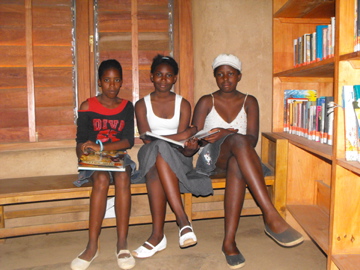
The new school session has been postponed due to the declared 21-day national mourning period for President Mwanawasa. Some kids from the shelter and the three girls pictured above who live in the surrounding neighborhood of Kamwala spent their would-be first day of school in the library. I asked the girls what they were reading which led to a discussion that was frankly shocking at first and drew a small crowd as the debate intensified.
When I lived in Harare, Zimbabwe, I spent time with girls from a nearby secondary boarding school next to my first residence. They were similar in their thirst for American pop culture, but I never heard any non-traditional statements about gender from them. I get the idea that things are beginning to change.
I recorded as much as I could, but unfortunately I can't transcribe much of it. Here's what I was able to get down.
The girls (from left): Ruth, 12, Mulala, 13 and Annie, 14
Books: Stanley and Livingstone: Expeditions Throughout Africa
Classic Fairy Tales
me: What are you reading?
Annie: I'm reading about African expeditions. This is the book our group worked with on Saturday.
(note: She's referring to a Saturday program offered at the library in which groups of four select books and present them to the class, usually as a skit.)
me: David Livingstone is a huge name in Zambia, of course. What do you think of him?
Annie: I like him because he was the first white man to reach Africa. I think he helped people to learn a lot. He helped the system of slavery. Some people hate him, but for those who understand what he did, they would not hate him...Here's a map of the ways he moved through Africa. He died in Africa but went back to Europe to be buried. He named the falls after Victoria, the Queen of England because she was in charge so it was out of respect.
me: How do you think Africa was different before he arrived?
Annie: They had their own system but they didn't have knowledge like in Europe. They were ignorant. Whites came to get slaves and often died because black people are stronger, so they survived. As for the white people, they knew slavery was bad. Black people thought trading people for goods was okay because they were ignorant.
People like from the United States, they didn't classify us as human beings. They thought only monkeys lived in Africa. It was sad.
me: So you're saying that white people were ignorant when it came to Africa, right?
Annie: Yes.
me: None of this makes you angry ?
Annie: No, because white people introduced technology and what was right and wrong.
(At this point, a few people came to listen and appeared upset by Annie's opinions.)
Mulala: You don't understand what you're saying, Annie. Zambians knew right from wrong. White people did some bad things to Africans. I don't know why you are saying this!
me: What do you mean by "what was right and wrong"?
Annie: Some came to explore rivers, mountains, deserts, the land. Morton, Speke, Park, men like this. Others came for missionary work. Let me explain them: they came to spread the word of God. They knew right from wrong. Africans did not know. Some Africans did not know slavery was wrong. In America, they opened plantations, that's where they took the slaves.
me: How do you think missionaries helped?
Annie: Because Africans put people in a big room if they did something wrong and exchanged them for things and gave them to whites as slaves. They didn't know right from wrong, you see.
me: So who taught you this?
Annie: My teacher at school.
me: This sounds like your teacher's opinion, doesn't it?
Annie: Yes, it's an opinion. Some agree, others think it's bad. Witchcraft was the culture before missionaries, and some people still practice it. It's used for selfish reasons sometimes.
me: So if you practice witchcraft, you don't know right from wrong?
Annie: No, it's just an opinion. It's doesn't mean they don't know right from wrong.
me: And it was around before missionaries, so maybe the missionaries didn't teach Africans right from wrong. Maybe Africans were not ignorant. Maybe Europeans, even missionaries, were ignorant themselves.
Annie: It was just a way of life. Maybe they were not ignorant.
(Now there was a small crowd of boys from the center listening to Annie.)
me: What about Colonial times? Sometimes Africans weren't treated fairly.
Annie: Yes, but if Africans weren't treated the way they were treated by Europeans, we wouldn't have education and other things.
Mulala: No, Annie! They took our minerals for themselves! They did not help us!
Annie: We benefited from it. We wouldn't have used those minerals, anyway.
Mulala: We did not benefit, Annie! Not until independence! Someone was faking you. We could have gotten something from it. Look at South Africa, which is a more developed country than Zambia. They were kept down by Apartheid and now they are free to develop their land. Slaves do not benefit from their owners!
(The crowd supported this statement with a few outbursts. I just slid into a corner with my pen and notebook.)
Annie: Slavery had advantages. One: slaves learned something. Slaves went to school.
Mulala: Annie! Slaves were NOT taken to school! They were sent to work for nothing. And for instance, say a slave went to United States and learned something maybe. Do you think they can come back to Zambia? They cannot!
Annie: Let's say Fountain of Hope is Africa and Kamwala High [School] is Europe. If they don't come to us, we learn nothing! Fountain of Hope needs Kamwala High School.
Mulala: The way it is now, many Europeans left Zambia and went back to Europe. Are you saying we are not learning now, without them? We are ignorant again in Zambia, Annie?
Annie: If Africa were left alone, we would be ignorant! We would not know God.
[from the crowd]: White people are not God!
The missionaries came with a bible and a gun, as they say. [laughs]
[The debate continued for some time, but Annie persisted with her ideas and it ended with "agree to disagree."]
Mulala: The white men, they have babies with Zambian women, but they never marry them! There was an Egyptian man who impregnated my cousin, but he didn't marry her. He went back to Egypt. Then she died, so we called him and he came to get his son who was five. He no longer calls us. According to me, it's wrong.
Annie: But they were lovers! It's okay because it's not allowed in Egypt.
Mulala: Maybe if she had gone to Egypt they would have killed her. She had another child, a daughter, who was half-Lebanese. They don't know who the father is, they just keep her here. My cousin was bad news! Okay, the Egyptian man thinks the girl is his child. She told us before she died. She needed him to send money for both children, so that is what she told him.
Annie: She had to lie to secure a future for her daughter.
me: How did she die?
Mulala: She was very sick. She was in her late twenties. Maybe malaria?
Mulala: I don't know if I would get involved with a white man now. It depends. The cultures are different, but some men are just good and some are not. Some would lie and tell me they would marry me but would not. Some men might accept the difference, some not. I would ask him first.
Annie: If a guy really likes a girl, he could lie and say it's okay but later say "no."
Ruth: Some people think that to keep a relationship, you have to follow what the guy wants. It's very bad, guys can be dangerous. They can try to control you. I'm very scared to love someone, get into a sexual relationship and find out he's [HIV] positive.
Mulala: Also, you could get pregnant. And then the guys can finish school, but you cannot.
me: Well, you can use...
Mulala: Condoms are not 100 percent.
Ruth: If someone is a prostitute, let's say, who's fault is it: the guy or the girl? Mualala says the girl.
Mulala: I did NOT say that, I said that the girl decides to do it.
Ruth: If no one went to prostitutes, no girls would become prostitutes.
me: Good point.
Mulala: We are called prostitutes if we do not follow the rules of dress here.
me: I know, I've experienced it. I didn't know dresses had to be below the knee, and I brought my summer dresses and some of them are above the knee. I don't know what to do! I wear this dress all the time.
Mulala: We can take you to the shops in Kamwala and help you find something. But it's not fair. If you buy a skirt, you must wear leggings under it. Then it's okay.
me: I bought a black skirt to my ankles that I feel kind of ridiculous in.
Mulala: I'm tired of these rules.
Mulala: Are these fairy tales true? Something in it?
me: You mean, are they based on true stories? Not exactly, no.
Mulala: Cinderella. It happens, so it's very interesting. The stepmother can treat you badly.
Annie: I've never come across any fairy godmothers. It's all lies.
Ruth: No, but the stepmother paying more attention to her daughters and not the stepdaughter can be true.
me: What do you think about Cinderella being saved by a rich man?
Mulala: That is not something good. In Zambia, many people think that will happen.
me: In America, many people think that will happen, too. I don't like the Cinderella story. I'll be honest.
Annie: As for me, I don't either. I think most rich people are mean, and they should marry rich people. A rich person and a poor person, that is not a good situation. It can bring bad things.
Mualala: We have a rich friend. She had a birthday party at a hotel, and her parents gave her a car and money. But her father is never around. He is in Tanzania or here or there. She has a driver because she's 13.
Ruth: She says, "I'm too hot to handle, too rich for any man to buy."
[Repeated by everyone a few times. I imagine this line refers to the dowry that remains as a standard procedure for marriage in Zambia.]
Ruth: Tell us: does true love exist?
me: Um...yes, of course it does.
all: No.
Mulala: In the movies it does, but it does not exist in life.
boy listening in: Yes, it does. You just do not know who is good and who is bad.
me: Do you guys want to take a walk?
Mulala: Yes, let's go.
I'm meeting these girls at the library again tomorrow. Mulala has texted me a few times to confirm. Excited to finally have some female friends at Lubuto!
Thursday, August 21, 2008
President Mwanawasa's Death and American Leaders

Trevor, 18
Trevor spent years on the street before his stay at Fountain of Hope Shelter. From there, he was sponsored to attend a boarding school. He now lives independently in Misisi Compound in Lusaka, Zambia.
Two days ago, on August 19th, President Mwanawasa's death was announced, and Zambia is in a seven day mourning period. Trevor selected a book about American Presidents, and we discussed the late Zambian leader, American leaders and politics in both Zambia and the United States.
Books: Our Country's Presidents by Ann Bausum
Autobiography of a People: Three Centuries of African-American History Told by
Those Who Lived It edited by Herb Boyd: excerpt from Where Do We Go from Here? by Dr. Martin Luther King, Jr.
me: What are your thoughts on President Mwanawasa's death?
Trevor: It's very sad. He was a good president because he brought democracy and fought corruption. He introduced departments to fight corruption. He helped change police force corruption by giving them higher salaries. In the past, the police collected money and let the criminals go. It will happens, but it happens less now.
me: Did the news inspire you to pick up this book?
Trevor: Yes. I really like JFK. I even saw a movie about him. His politics helped people, but he was killed in a car because of his politics. Opposition leaders wanted to take charge because President Kennedy was active.
This is like Mwanawasa. Some liked him, and some hated him because he offered something new. I can't tell if someone killed him or not. They say he collapsed at the African Union Summit, but they do not tell us how. Maybe someone put something in his water. By the time he was taken to the hospital, he was in a coma. I'm very very sad. I supported him.
In sub-Saharan Africa, if you can imagine, we are the only country with peace. No violence, no civil war. You go to Angola, Congo [DRC], Kenya, even Malawi in the past and South Africa where they don't like Zimbabweans, and they are killing people. Zambia is not that way.
me: Do you think Mwanawasa is like any of the presidents in this book?
Trevor: Maybe Clinton. I like Clinton. America has been in wars, like those introduced by President George W. Bush, but Clinton was a wise man and did not do the same. I thought his wife would have been wise. I don't know why she wasn't voted. I supported her. I don't know if Obama would be good.
Sata would not be a good president. He doesn't like foreigners, and that is bad. But I do not like the wages that foreigners give to Zambians. They are too low.
Where are you coming from?
me: New York City.
Trevor: Is New York the capital, as well? Or is it just Washington?
me: Ha! Just Washington.
[enter long conversation about New York.]
Trevor: Here is Bill Clinton. And here is Martin Luther King. Was he a prime minister? He was not a president.
me: No, he was a civil rights leader. Do you want to read about him? I can tell you about him, too, although I'm sure I don't remember everything!
Trevor: Yes! Please, where is it?
[after reading some of it]
Trevor: This is a very nice book. I will read the words of Martin Luther King.
[later in the day]
Trevor: I love this book. I knew some before, but now I know what he was doing in America. I like the statement by John Kenneth Galbraith. He said that if you could spend 35 billion dollars on the Vietnam War and 20 billion to send a man to the moon, why can't America spend something to get blacks back together? It's an interesting idea. I've benefited from American donors in terms of education. The doctors help develop the drugs for HIV/AIDS, and we depend on that help. America should help as much as they can.
Also, Martin Luther King talked about love. Not the romantic love. He said where there is love, there is no violence. You can't pull dark from darkness. You can't murder hate.
[long discussion following...]
me: Aren't you glad you read this today?
Trevor: Yeah, yeah. It explains a lot. Tomorrow I will read another one from this book. Maybe one per day.
me: Great! I'll be here again to discuss it with you.
Trevor: Shall we meet tomorrow, say 13 hours?
me: Okay, see you then!
Trevor: Look! There is one called "LL Cool J on rap."
me: That is hilarious. Let's read that one, too.
Wednesday, August 13, 2008
Tonga Village Visit
I had the incredible opportunity to visit a Tonga village in the Southern Province of Zambia with a friend who spent his childhood there. Singani village has not been exposed to missionaries or aid workers, so it was quite a culturally enriching experience.
I purchased a traditional chitenge to wear out of respect for their way of life. Chitenges are often worn in Lusaka, as well. I slept in a mud hut and participated in the rigorous daily tasks of the Tonga women, including fetching water from the well for cooking and bathing and carrying it on my head, attempting (and failing) to hold firewood on my head, selecting a live chicken and preparing it, sweeping around the huts in the morning amongst the guinea fowl, and preparing dinner around fires we built in the evening.
I learned a great deal about herbal remedies and even spoke to a local healer. One of the grandmothers and I were able to communicate through my friend's translation. She explained that slavery continued long after the government and historical texts reported its end. White tobacco farmers started a hybrid language called Chilungu Boy to speak to their workers, and she remarked that she wished I knew it. It was surreal to have someone imagine that I might speak a "language" born out of slavery. She also described the annihilation of game populations after rampant poaching, among other fascinating tales of Colonization's effect on village life.
I packed a book from the Lubuto collection with me. I was breaking the rules by removing a book from the library, but books simply do not exist in villages, and I couldn't resist the once in a lifetime chance to share a story with the children there. On the long, late, uncomfortable bus ride (a given in Africa), I had my friend translate the story to Tonga and help me with pronunciation. I made sure to select a story without Western references or aspects of modernity they wouldn't recognize.
The children loved the book, lingering on every word. There is a strong possibility their acute attention was due in part to my presence in general, but it was a Lubuto success nonetheless.
It was an honor to be welcomed in Singani village. I distributed much needed and seldom affordable products: bars of soap, Mealie Meal to make nshima, cooking oil, sugar...and some much appreciated Cadbury products, as well! I was presented with a pineapple from the gardens as a parting gift.
Below are two photos of the children's story time and two for the sake of cuteness.
I purchased a traditional chitenge to wear out of respect for their way of life. Chitenges are often worn in Lusaka, as well. I slept in a mud hut and participated in the rigorous daily tasks of the Tonga women, including fetching water from the well for cooking and bathing and carrying it on my head, attempting (and failing) to hold firewood on my head, selecting a live chicken and preparing it, sweeping around the huts in the morning amongst the guinea fowl, and preparing dinner around fires we built in the evening.
I learned a great deal about herbal remedies and even spoke to a local healer. One of the grandmothers and I were able to communicate through my friend's translation. She explained that slavery continued long after the government and historical texts reported its end. White tobacco farmers started a hybrid language called Chilungu Boy to speak to their workers, and she remarked that she wished I knew it. It was surreal to have someone imagine that I might speak a "language" born out of slavery. She also described the annihilation of game populations after rampant poaching, among other fascinating tales of Colonization's effect on village life.
I packed a book from the Lubuto collection with me. I was breaking the rules by removing a book from the library, but books simply do not exist in villages, and I couldn't resist the once in a lifetime chance to share a story with the children there. On the long, late, uncomfortable bus ride (a given in Africa), I had my friend translate the story to Tonga and help me with pronunciation. I made sure to select a story without Western references or aspects of modernity they wouldn't recognize.
The children loved the book, lingering on every word. There is a strong possibility their acute attention was due in part to my presence in general, but it was a Lubuto success nonetheless.
It was an honor to be welcomed in Singani village. I distributed much needed and seldom affordable products: bars of soap, Mealie Meal to make nshima, cooking oil, sugar...and some much appreciated Cadbury products, as well! I was presented with a pineapple from the gardens as a parting gift.
Below are two photos of the children's story time and two for the sake of cuteness.


Subscribe to:
Posts (Atom)